AI Empowering High-Quality Development in Cultural Tourism
2026-04-07
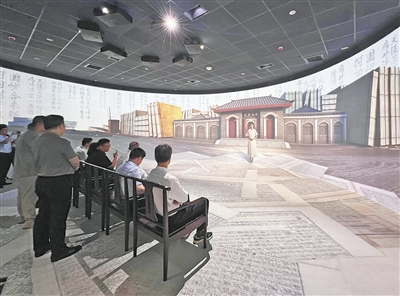
The 14th Five-Year Plan emphasizes the role of digital technology and data in enhancing people’s lives and improving welfare across various sectors, including education, healthcare, and cultural tourism.
In Hunan’s Hengyang, the Chuan Shan Academy is using AI to create immersive cultural tourism experiences. In Hangzhou, the AI cultural tourism assistant “Hang Xiaoyi” acts as a digital tour guide. In Dalian, the smart tourism platform “Xingyou Dalian” offers personalized travel itineraries. In recent years, cultural tourism has been rapidly upgraded towards immersive, intelligent, and personalized experiences, thanks to AI.
Cross-Time Dialogue: Enriching Cultural Experiences
In the spring, a cross-time “dialogue” is taking place at the Chuan Shan Academy in Hengyang, Hunan. Visitors wearing AR glasses see Wang Fuzhi, dressed in traditional robes, interpreting the philosophical thoughts from “Zhou Yi Wai Zhuan”. This immersive scene brings to life philosophical wisdom from over 300 years ago.
Founded in 1878, the Chuan Shan Academy is a significant origin of Huxiang culture, dedicated to promoting the thoughts of philosopher Wang Fuzhi from the late Ming and early Qing dynasties. Wang advocated for practical application of knowledge, significantly influencing modern Chinese thought.
Previously, the academy’s static exhibits made it difficult for visitors to fully appreciate Wang’s essence. In 2025, the academy launched the AI Digital Human project, utilizing natural language processing to present Wang’s likeness and voice. Visitors can engage in conversations with the virtual Wang and trigger AR annotations of his works through gestures, transforming classical texts into dynamic illustrations. “We hope visitors actively engage with knowledge rather than passively receive it, experiencing the contemporary value of Wang’s thoughts through dialogue,” said Chang Bin, the academy’s planning manager.
In the AI interactive lecture hall, visitor Zhou Liqian asks the virtual digital human, “How does the teacher view the relationship between knowledge and action?” The digital human responds with references and explanations. “It’s not a one-way lecture but a dialogue of ideas,” Zhou remarked.
“Talking to Mr. Wang is much more vivid than a history class!” exclaimed visitor Zhang Yu from Guangzhou. Data shows that in 2025, the academy’s visitor numbers increased by 110.84%, with study groups making up 59.26%. Many parents believe this immersive dialogue can spark their children’s interest in learning.
“AI does not simply replicate history; it analyzes millions of texts, including Wang’s writings and letters, to construct an interactive logic that aligns with his philosophical context,” explained the AI Digital Human project technical team leader. “We filtered out potential biases from AI to ensure the dialogue strictly adheres to the essence of Wang’s teachings.”
At the Chuan Shan Academy, technology and culture merge, allowing traditional culture to be passed down through light and shadow.
Smart Digital Guides: Convenient and Informative
At West Lake in Hangzhou, visitor Yuan Meng interacts with a blue “smart sticker” at a cultural tourism consultation kiosk. Instantly, a charming girl in a qipao named “Hang Xiaoyi” appears on the screen, providing real-time city tour guidance and information.
“Is there a crowd at Leifeng Pagoda now?” Yuan asks Hang Xiaoyi via voice. The digital guide quickly responds with the current visitor numbers at popular West Lake attractions. “This is much easier than checking on my phone; it’s like having a free tour guide by my side,” Yuan said.
“Can you recommend a route to visit the Broken Bridge?” Yuan inquires. Within five seconds, Hang Xiaoyi sends a classic boat tour route for “Broken Bridge Residue Snow”—starting from Hubin Pier, visiting the Broken Bridge, then exploring Beishan Street’s architecture from the Republic of China era, and finally heading to Baoshi Mountain for a view of West Lake.
Following the guide, Yuan and her group board a boat, with Hang Xiaoyi narrating, “Drifting on the lake, the ripples dance, showcasing a landscape of mountains and city. The Broken Bridge Residue Snow is one of West Lake’s ten scenic spots, adorned in winter’s silver coat, appearing broken yet whole.”
“Hang Xiaoyi not only introduces attractions but also educates about the historical and cultural significance along the way, which is wonderful,” Yuan noted. Additionally, Hang Xiaoyi provides thoughtful reminders: “Although we won’t directly stop at Liuhe Pagoda or Guangji Bridge, feel free to ask me about routes or stories anytime.”
“By utilizing Hang Xiaoyi, management and businesses can precisely serve tourists while also gathering feedback on their preferences, providing data support for improving service quality and expanding offerings,” said Bo Wengan, deputy director of Hangzhou’s Cultural and Tourism Development Center.
Zhou Jiayi, director of the Hangzhou Craft Living Museum, has experienced this firsthand. Located near the Hangzhou Arts and Crafts Museum cluster, attracting visitors is crucial. “Recently, many visitors told me they came because of Hang Xiaoyi, which surprised me,” Zhou shared. “The museum showcases over 20 unique crafts and intangible cultural heritage techniques, allowing visitors to participate in experiences, making it well worth a visit.”
Now, if visitors ask Hang Xiaoyi about intangible cultural heritage sites near the West Bridge, she recommends the Craft Living Museum based on historical data. “Previously, we introduced AI glasses; when worn, Hang Xiaoyi introduces intangible cultural techniques right before your eyes, resulting in more visitors engaging in experiences,” Zhou added.
Consulting the Travel Butler: Efficient and Professional Itinerary Customization
In spring, at Lianjiao Bay in Dalian, the blue sea is calm, and the European-style buildings across the shore are colorful and romantic, with seagulls soaring overhead.
“What a great shot!” exclaimed visitor Song Yao, admiring a photo with her friends, capturing the sea, buildings, and seagulls in one frame. “This photo spot and composition were suggested by AI!” Song happily shared.
The AI she referred to is the local smart cultural tourism platform, “Xingyou Dalian” mini-program, which features an AI intelligent route planning function.
Opening the dialogue box, Song sees the itinerary generation process for her Dalian trip.
“What attractions are suitable for visiting in Dalian?” Song begins her conversation with the mini-program.
The program suggests classic attractions like Dalian Shengya Ocean World and Dalian Forest Zoo. Feeling the suggestions are too generic, she refines her request: “Where are the best photo spots in Dalian?” This time, trendy locations like Fisherman’s Wharf and Nanshan Style Street appear in the answers.
Continuing her inquiries, Song asks, “How can I take good photos at Fisherman’s Wharf?” The program advises, “Capture the wharf’s panoramic view from a nearby observation deck to highlight the architectural layers and harbor. The Lianjiao Bay observation deck offers a great view of Fisherman’s Wharf, perfect for photography. It’s best to visit on a sunny afternoon; take Metro Line 5 to Hutan Park Station and walk about 20 minutes.”
“It’s like having a thoughtful ’travel butler’ that saves me from switching between different platforms for travel, accommodation, and dining. I just need to describe my needs accurately and completely, and it provides a comprehensive guide. For specific interests, I can ask further questions,” Song explained.
Not long after chatting with the mini-program, Song has nearly finalized her desired locations. She then requests, “Design a two-day itinerary for Dalian, including Lianjiao Bay, Dongguan Street historical cultural district, and an experience on the tram while encountering sika deer in the afternoon at Lianjiao Bay.”
Moments later, a detailed personalized guide appears in the dialogue box: Day one covers the coastal route, visiting the ocean world, Lianjiao Bay, and seeing sika deer; Day two explores the urban streets. “I am very satisfied with this itinerary, as it allows me to experience Dalian’s marine culture and the city’s historical charm,” Song said.
“By integrating AI models, the ‘Xingyou Dalian’ mini-program has upgraded to an intelligent ’travel butler’, enhancing planning efficiency and visitor experience,” introduced Shan Meina, director of Dalian’s Cultural and Tourism Bureau. The mini-program has accumulated nearly 430,000 users.
Comments
Discussion is powered by Giscus (GitHub Discussions). Add
repo,repoID,category, andcategoryIDunder[params.comments.giscus]inhugo.tomlusing the values from the Giscus setup tool.