Key Points
- The rapid adoption of artificial intelligence in American companies has led to a hiring freeze for entry-level positions in the AI sector, leaving many young graduates with degrees struggling to find jobs.
- Major companies like Ford, Nvidia, and AT&T are building AI infrastructure and urgently need skilled blue-collar workers.
- AT&T plans to invest approximately $38 billion over the next five years to recruit and train frontline technical workers, primarily to expand its fiber network.
In the corporate boardrooms from Dayton, Ohio, to Dallas, the driving force behind AT&T’s new development phase is no longer fresh graduates holding expensive four-year degrees, but rather blue-collar workers who are willing to work hard and possess practical skills. Currently, there is a significant market gap for these technical workers.
AT&T CEO John Stankey stated in an interview with CNBC, “We need talent proficient in electrical operations and photonics, capable of on-site infrastructure installation and ensuring equipment operates normally.”
“We have to actively seek talent, conduct professional training, and implement incentive policies to attract workers, as these technical roles are in high demand in the U.S. market.”
This spring, the number of college graduates in the U.S. reached a historical high, yet companies are struggling to find blue-collar workers, highlighting the severe employment crisis facing recent graduates in the wake of the AI revolution.
For a long time after World War II, there was a clear development path in American society: completing college and obtaining a diploma was a ticket to the middle class. As factory jobs were gradually replaced by office jobs, American society increasingly valued degrees over manual labor, making a four-year college diploma the most mainstream route to social mobility. However, with the comprehensive integration of AI into American companies, which is gradually replacing the basic clerical jobs traditionally available to graduates, the career benefits associated with a degree are eroding.
Currently, AI has not yet triggered large-scale layoffs or created job vacancies, but many graduates, especially those in industries susceptible to AI replacement, have already sensed that a college diploma no longer guarantees quality employment opportunities as it once did.
As companies fully implement AI technologies, management has discovered that they can streamline labor through technology, causing the overall hiring pace to slow. Newcomers lacking practical experience, as well as those in marketing, legal, accounting, human resources, and information technology—fields vulnerable to AI penetration—are facing the most significant employment impact.
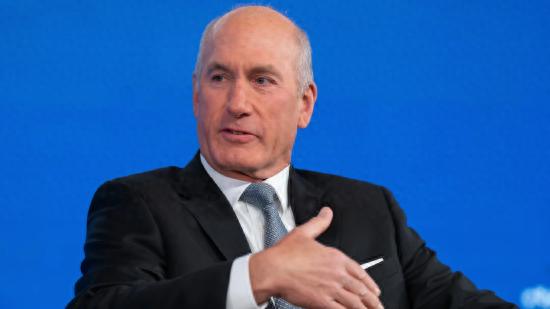
AT&T CEO John Stankey
If this trend continues, AI may reshape the American labor market and the global economic landscape, altering the map of employment opportunities. Many leading economists and tech industry professionals acknowledge that the deeper impacts of this shift are yet to be fully explored.
26-year-old tech worker Mei Hu has transitioned to a social media influencer after leaving Deloitte last year due to performance issues. She stated, “AI is gradually dimming the American dream; the public’s concerns are not unfounded. In the past, most people aspired to be white-collar workers, and going to college was the only way, but now that path has changed.”
Every technological revolution creates new job opportunities, but the reality is harsh for recent graduates: many of the new positions generated by the AI wave are concentrated in data center construction and operations, primarily in blue-collar practical roles that do not require a four-year degree.
However, there are concerns in the industry that once the current wave of infrastructure construction for chip factories and data centers subsides, the employment benefits for blue-collar jobs may not be sustainable.
Companies such as Ford and Nvidia have acknowledged the urgent need for a large number of industrial workers to support infrastructure development.
Nvidia CEO Jensen Huang stated at the World Economic Forum, “This is an unprecedented wave of infrastructure construction in human history, which will create a vast number of job opportunities for plumbers, electricians, construction workers, steelworkers, network technicians, and equipment installation personnel.” He also mentioned that there is a significant shortage of such technical workers in the U.S., with salaries for these positions likely to reach six figures in the future.
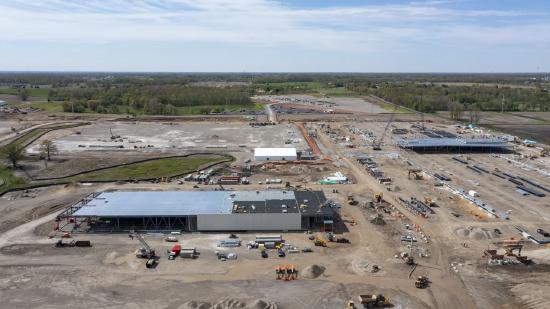
In March, AT&T announced plans to invest $250 billion over the next five years to expand its fiber network to meet the operational needs of AI data centers and address the surge in demand for network usage driven by AI development and mobile streaming services.
The company stated that about 15% of this investment would be allocated to employee recruitment and training, primarily focusing on frontline blue-collar technical personnel rather than white-collar positions at corporate headquarters.
John Stankey remarked, “For a long time, American society has overly revered college degrees, which has some merit but has also gradually led to misconceptions. Today, the rising cost of higher education far exceeds inflation, while the market is severely lacking practical technical talent such as HVAC technicians, electricians, and fiber maintenance technicians, which is unreasonable.”
The Origin and Evolution of the American Dream
According to the National Center for Education Statistics, in the early 20th century, only 10% of American teenagers completed high school, and even fewer pursued higher education. At that time, schooling meant a decrease in family income, and most Americans could only work in factories and fields to make a living, with few opportunities for comfortable, respectable jobs.
After World War II, the situation changed dramatically. The G.I. Bill provided veterans with free college education, leading to a boom in public universities across the country. Montclair State University history professor Shannon Clark noted that both parties in the U.S. reached a consensus that expanding higher education was a valuable social investment, as a highly skilled workforce could effectively enhance overall productivity.
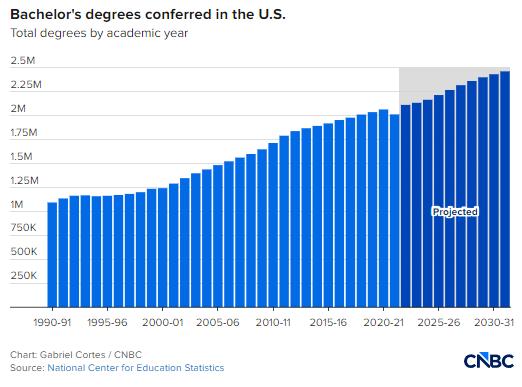
In the following decades, countless Americans left the hot factory floors for comfortable office environments, trading in tools for office equipment, and transitioning from hourly wages to stable monthly salaries. Women and minorities entered the workforce in large numbers, leading to rising wages and improved living standards, which further fueled technological innovation, globalization, and economic growth. By the end of the 20th century, there was a widespread belief in American society that obtaining higher education, combined with personal effort, was a reliable path to achieving the American dream.
Data confirms that those with four-year college degrees earn higher lifetime incomes and have lower unemployment rates. However, in recent years, the notion that “going to college is the most reliable way to achieve the American dream” has begun to waver. On one hand, the skyrocketing costs of higher education and increasing student debt have raised questions about the return on investment for degrees; a survey by the New York Federal Reserve indicates that the return on investment for a college degree is about 12.5% in 2024, still valuable but has not exceeded 13% in the past three decades.
Now, the widespread adoption of AI further diminishes the market value of degrees.
Alan Cheris, head of Bain & Company’s global retail business, stated, “AI is like an endless stream of agile thinkers lacking practical experience, taking over the basic tasks that recent graduates used to handle.”
Multiple surveys confirm that the difficulty of job hunting for recent graduates continues to rise. Data from the New York Federal Reserve shows that the average unemployment rate for graduates aged 22 to 27 has been 4.5% since 1990, and it is projected to rise to 5.4% by 2025.
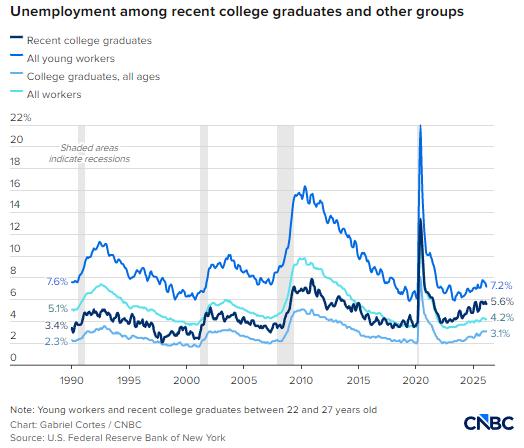
Among these, entry-level workers in industries vulnerable to AI penetration face the toughest situations. A research paper from Stanford University’s Digital Economy Lab indicates that from mid-2024 to September 2025, the job growth rate for newcomers in software development, marketing, and sales management—fields highly susceptible to AI—will lag behind those in lower-risk industries by 16%.
The research team, relying on data from payroll provider ADP, found that even after excluding external variables such as business difficulties, interest rate hikes, and remote work, this employment gap still exists; only positions that involve collaborating with AI rather than being fully replaced by it have shown stable job growth.
The paper’s author, Eric Brynjolfsson, a leading scholar in the field of AI economics, stated, “Initially, this employment gap was only 13%, but it has now widened to 16%, indicating that this is not a short-term market fluctuation, and the negative impact is deepening. If the employment difficulties of young people continue to escalate, it will eventually affect the entire U.S. labor market.”
Senior economist Lee Tucker from the U.S. Census Bureau’s Economic Research Center conducted in-depth research based on quarterly workplace indicators, further confirming this phenomenon: after the launch of ChatGPT in late 2022, the recruitment scale for the 22 to 24 age group in AI-related industries such as finance, insurance, and professional services dropped by 9%, far exceeding other industries.
From the third quarter of 2022 to the second quarter of 2025, the number of young employees in these industries is expected to decrease by 12% to 15%, resulting in a loss of about 150,000 entry-level positions. Although there are signs that the employment downturn began to emerge in 2020, it cannot be entirely attributed to AI; the core reason is that companies are reducing the number of new hires rather than conducting large-scale layoffs.
The Cooling of Entry-Level White-Collar Positions
The rapid deployment of generative AI and autonomous AI can take over a significant amount of basic workplace tasks, casting a shadow over the development prospects of traditional entry-level positions such as investment banking analysts, consulting newcomers, and junior associates at top law firms.
Many companies are faced with the dilemma of whether to continue hiring large numbers of recent graduates from prestigious universities to invest in long-term talent development or to reduce hiring and rely on AI to replace basic human labor.
The Chief Data Officer at JPMorgan stated in an interview that the bank currently has no clear plans for layoffs or hiring expansions, but does not rule out optimizing personnel structure, and future hiring scales may fluctuate based on market demand.
At the same time, the work content for new entrants will also change; they will no longer be buried in basic tasks but will focus on managing AI systems. Companies are increasingly favoring young professionals who are proficient in various AI tools and skilled in practical applications.
Many corporate managers assert that recent graduates who can only use AI to edit documents and search for information have already lost their competitive edge; only those who master specialized AI operational skills and can significantly enhance work efficiency through AI will successfully receive job offers.
In contrast, traditional college curricula are mostly fixed in theoretical knowledge, which AI can quickly master in a short time, making it difficult for inexperienced graduates to highlight their irreplaceability.
Currently, major universities in the U.S. are being forced to accelerate curriculum reforms and adjust talent training models to align with the workplace demands of the AI era. Leaders of future workplace research institutions assert that today’s young people must develop mature workplace skills in advance, bypassing basic internships to directly qualify for mid-level positions.
The speed of university transformations directly determines the extent to which AI will impact the career development of graduates.
Economists at the RAND Corporation have noted that past graduates repaying student loans and incoming freshmen will be the groups most affected by this workplace transformation. If the youth employment slump cannot be reversed, it could lead to long-term employment trauma, resulting in unemployment, lower job tiers, and reduced lifetime earnings. If the pathways to middle-class advancement are obstructed, it could trigger a series of economic and social issues, including shrinking consumption, a cooling housing market, and widening wealth gaps.
The Happy Life of Blue-Collar Workers
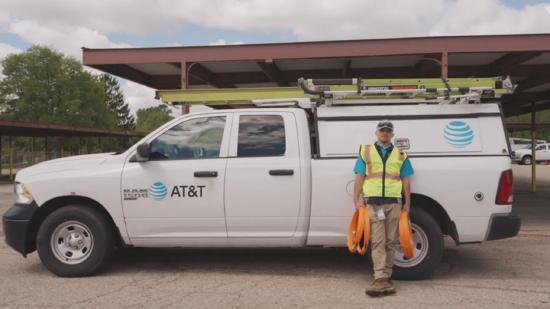
24-year-old Kason Cook dropped out of school early to work as a field technician at AT&T. Later, he returned to school with the help of the company’s tuition reimbursement policy. Now, he lives in a three-bedroom house in Ohio, with no debts other than his mortgage, and finishes work around 4:30 PM, allowing him to spend time with his family and enjoy leisure activities. His life is stable and prosperous.
He is primarily responsible for the installation and debugging of fiber optic networks, following in the footsteps of his father and grandfather, who both worked for the company. After dropping out in 2022, he realized he was better suited for practical work; within just a year, he saved enough to buy a house. After starting a family, he decided to pursue a bachelor’s degree again, with all tuition costs covered by the company.
Over the past decade, AT&T’s global workforce has been reduced by more than half, but the company is now specifically expanding its recruitment, bringing in a large number of skilled workers who do not require a college degree. The company plans to add 3,000 technical personnel this year while continuing to expand hiring in areas with labor shortages. In the past three years, it has recruited over 10,000 technical workers, with training costs per person ranging from $50,000 to $80,000.
Data from the construction industry indicates that there is currently a shortage of about 350,000 technical workers in the U.S. construction sector, which may expand to 450,000 next year, with an estimated 2.1 million technical positions unfilled by 2030. The industry has a high proportion of older workers, with over 20% of electricians aged over 55, further exacerbating the labor shortage.
Meanwhile, the unemployment rate for individuals aged 25 and older with a bachelor’s degree has slightly increased. Except for the pandemic period, the unemployment rate for this group has remained stable at below 3% for nearly a decade, but it has now shown a noticeable rise.
Data from the Bureau of Labor Statistics shows that since 2023, the unemployment rate for management and clerical white-collar positions has been rising annually, while the unemployment rate for blue-collar positions in construction and operations has remained stable or even decreased.
Of course, college degrees still hold irreplaceable value; overall, higher-educated individuals earn higher lifetime incomes and are more resilient to unemployment risks. Workers with high school diplomas or less are more likely to face layoffs during economic downturns, and their long-term unemployment rates are significantly higher than those with bachelor’s degrees.

To attract more quality technical workers, AT&T has introduced generous benefits policies: signing bonuses and retention bonuses for frontline technical positions range from $5,000 to $10,000, with hourly wages between $18.18 and $31.45, along with comprehensive social security, retirement benefits, tuition reimbursement, childcare subsidies, and communication fee discounts.
John Stankey urges society to shift its entrenched views and not to blindly advocate for everyone to pursue four-year degrees. Instead, there should be a rational planning of educational and career paths based on industry needs, recognizing the social value and development prospects of technical roles.
For a long time, white-collar jobs have been sought after for their social status and comfortable work environments, while blue-collar jobs are often viewed as physically demanding, with harsh working conditions and certain safety risks. Telecommunications installation and maintenance work is particularly hazardous, requiring workers to have physical strength and adapt to holiday shifts and outdoor work in adverse weather conditions.
Despite the challenges, Kason Cook remains committed to his technical position, stating that if he had insisted on finishing college and pursued a white-collar path, he would likely be burdened with significant student loans, without a house or savings, and earning far less than he does now. What reassures him most is that this practical blue-collar job is almost immune to being replaced by AI.
Comments
Discussion is powered by Giscus (GitHub Discussions). Add
repo,repoID,category, andcategoryIDunder[params.comments.giscus]inhugo.tomlusing the values from the Giscus setup tool.